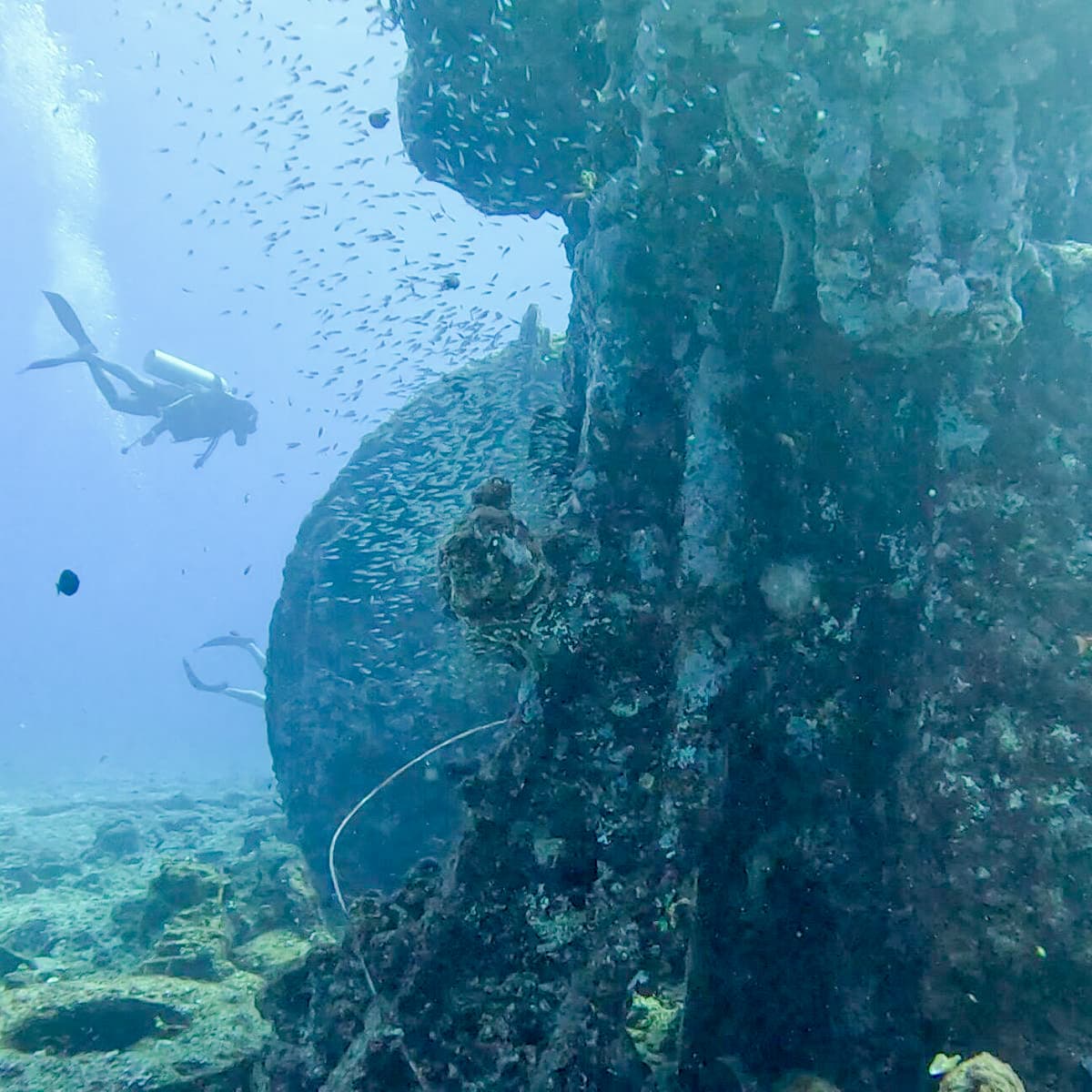
The Great Basses Reef lies 9 nautical miles offshore from the small fishing town of Kirinda on Sri Lanka's south-east coast. It is accessible by boat for approximately 50 days each year --- the narrow inter-monsoon window between mid-March and mid-April when neither the north-east nor the south-west monsoon is blowing. The most famous wreck on the reef is the coin ship: a 24-gun Mughal trading vessel of Emperor Aurangzeb (1658--1707), discovered by Arthur C. Clarke and Mike Wilson in 1961, lying at 20 metres in a surge-prone passage of reef with thousands of silver coins originally recovered. The Great Basses Lighthouse --- a Victorian granite tower built in 1873, 37 metres tall, standing in the middle of the sea --- is visible from the Kirinda shore on clear days. This package builds to the Basses through some of the finest reef and wreck diving on the west and south coasts.
Kalpitiya --- Bar Reef & spinner dolphins
The largest reef system in Sri Lanka. Spinner dolphins before breakfast.
Bar Reef Marine Sanctuary --- one of the largest coral reef systems in Sri Lanka, gazetted in 1992. Hawksbill turtles, leopard sharks, reef fish at accessible depths. The morning dolphin safari delivers spinner pods of 300 to 500 animals before breakfast --- a number that genuinely surpasses anything the south coast offers. Non-divers snorkel the same reef as divers. Two nights.
The sanctuary reef supports hawksbill sea turtles, leopard sharks, and a recovering coral ecosystem that has been protected long enough to show genuine regeneration. Accessible to all certification levels. The dive operator at Kalpitiya will tailor the site to the group's mix of experience.
The early morning boat reaches the dolphin grounds in 30 minutes. Pods of 300 to 500 spinner dolphins ride the bow wave, leap, and spin around the vessel for 45 minutes. The noise of that many animals surfacing simultaneously is something no photograph captures.
The flat lagoon adjacent to the reef provides consistent wind and flat water ideal for beginner kite surfing. Available for guests who want an active afternoon between dive sessions.
The Kalpitiya peninsula is a sandbar a few hundred metres wide in places --- a Muslim fishing community with a small Portuguese Catholic minority descended from 17th century settlement. A walk with the guide through the village is the correct introduction to the north-west coast's layered history.
Hikkaduwa --- coral gardens, wrecks & turtle beach
Sri Lanka's original dive destination. The reef that started the industry. Still excellent.
Hikkaduwa Marine National Park was Sri Lanka's first gazetted marine protected area. The coral gardens are accessible by snorkel directly from the beach --- some of the most approachable diving in the country. Green sea turtles at Turtle Beach arrive at dawn routinely and can be observed from the sand. The SS Conch wreck, the Kirala Gala drop-off, and the Coral Garden Cave are all within a short boat ride. For the guest who has never dived, Hikkaduwa is the correct introduction. Two nights.
Colourful tropical fish, clown fish, angel fish, snappers, black corals, and sea turtles in the shallow water of the marine national park. Accessible by snorkel from the beach or by short boat to the deeper sections.
A sunken British oil tanker now encrusted with coral and reef fish. The wreck structure is clear and accessible. Surrounded by fusiliers, groupers, and lion fish. Excellent for underwater photography.
One of the deepest dive sites at Hikkaduwa. Rare black corals and large pelagic species. For certified divers who want something beyond the coral gardens.
Green sea turtles come to shore along the Hikkaduwa beachfront early in the morning. They come routinely and can be observed without entering the water. Twenty minutes before the beach becomes busy.
Unawatuna & Galle --- the Rangoon wreck and the fort
A 100-year-old British steamer. A 400-year-old colonial fort. The same afternoon.
The SS Rangoon at Unawatuna is a 100-year-old British steamer at 18 to 30 metres --- now an artificial reef hosting barracuda, trevally, batfish, and rays. Intermediate level. The Napoleon Reef and Jungle Bay offer shallower alternatives for beginners. Galle Fort in the afternoon: the Dutch rampart walk at dusk, the 1755 Dutch Reformed Church, the colonial street grid still navigated daily. A private dinner on the western rampart is available as an add-on. One night.
A British steamer lost approximately 100 years ago, now fully colonised by soft and hard coral. Barracuda patrol the superstructure. Trevally, batfish, and eagle rays move through the hull sections. Visibility is good in the November to April season.
Shallower dive sites within the Unawatuna bay area --- suitable for beginners and for guests who want a gentler dive after the Rangoon. Good coral and reef fish.
The best-preserved colonial sea fort in Asia. The full perimeter walk of the ramparts takes 45 minutes. The western rampart --- facing the open ocean --- should be saved for dusk. The lighthouse clicks on as the last light leaves the 400-year-old stone. This is the correct way to spend the evening after a day of diving.
Built in 1755 with original black and white marble floor tiles and tombstones set into the floor. The Dutch street grid carries its original names. Walk the fort interior with a guide who knows each building's history.
Mirissa --- blue whale watching & reef dive
The largest animal that has ever existed. Six kilometres offshore. This is why the departure is at 6am.
The deep-water channel south of Mirissa is one of the top three blue whale sighting locations on earth. Responsible operator --- small boat, marine biologist on board, no chasing, no circling. Spinner dolphin pods in the channel before the whale grounds. Blue whale sighting rate exceeds 90% in peak season (November to April). Afternoon reef dive for divers. One night.
Departure at 6am. At 60 metres distance, the blue whale surfaces for three to five breaths then dives for fifteen minutes. The scale --- a creature 30 metres long and 4 metres wide --- does not register until you are next to it. Ophiro uses a responsible, biologist-staffed operator. Not the mass-market fleet.
The channel between Mirissa and the whale grounds supports resident spinner dolphin pods. Schools of several hundred dolphins ride the bow wave. The spinner dolphin leaps for no biological reason science has satisfactorily explained.
An afternoon dive on the Mirissa reef at 15 to 25 metres --- coral formations, reef fish, and the occasional turtle. A worthwhile second session on a day structured around the morning whale watch.
Kirinda & Great Basses Reef
A Mughal coin ship. A Victorian lighthouse in the middle of the open sea. The most remote dive in Sri Lanka.
The Great Basses Reef lies 9 nautical miles (approximately 17km) offshore from Kirinda --- reachable only during a window of approximately 50 days each year, between mid-March and mid-April. Diving is conducted under the supervision of the Malima Diving Club (Sri Lanka Navy, Kirinda, +94 71 772 5903) and the Sri Lanka Coast Guard. The boat ride takes 45 minutes to one hour. Strong currents and surge conditions require experienced divers who are comfortable with unpredictable conditions. The reward is access to dive sites that are among the rarest in Asia.
The most famous wreck in the Basses: a 24-gun trading vessel of the Mughal Emperor Aurangzeb (1658--1707), sunk by a storm and discovered in 1961 by Arthur C. Clarke and Mike Wilson. Thousands of silver coins were recovered. The wreck lies accessible only through openings in the reef, with strong currents making the dive challenging. The correct dive briefing treats this not as a technical dive but as a surge dive requiring composure in unpredictable conditions.
A Dutch-origin wooden steam ship whose hull was made of copper plates. The copper has survived centuries of salt water and is clearly identifiable on the seabed. Shallow enough to be accessible to experienced recreational divers, but surge conditions at Little Basses require the same respect as the Great Basses.
A Victorian-era wreck with the top of its engine only 2 feet below the surface at the lowest tide. Accessible to intermediate divers but surge conditions at the surface make the entry and exit the most demanding part of the dive. Correct conditions must be confirmed before departure.
A Victorian granite tower, 37 metres tall, built in 1873 by the British colonial government, standing in the middle of the open Indian Ocean, 9 nautical miles from shore. It still operates. The sight of it on the horizon as the boat approaches is extraordinary. At close range it is stranger still.
Kirinda sits at the eastern entrance to Yala Block 1. A dawn safari on the morning before the Basses departure --- or on the return morning --- adds leopard, elephant, sloth bear, and crocodile to a day that already contains coin ships and Victorian lighthouses. The combination is available almost nowhere else on earth.
Arugam Bay --- optional extension
The east coast. The circuit completes.
The western window closes naturally at Kirinda / Yala. For guests who want the full southern arc --- from Kalpitiya on the north-west coast to Arugam Bay on the east coast --- this extension adds one to two nights and completes a genuine circumnavigation of Sri Lanka's dive coastline. Optional and can be omitted if returning directly to Colombo from Kirinda.
The east coast reef at Arugam Bay --- accessible by short boat from the beach --- rounds out the diving geography of the journey.
Wild elephants at dawn in the mangrove channels. One of the most unexpectedly dramatic wildlife experiences on the east coast.
The 2,000-year-old cliff temple above the bay --- where Princess Viharamahadevi is said to have arrived from the sea. A journey built around the ocean should close here.
**Technical dive requirements** HMS Hermes, Catalina Y-78, and RFA SS Athelstane (PKG 08A) all require technical diving certification (TDI, PADI TecRec, or equivalent) and mixed gas equipment (nitrox or trimix, depending on depth). Ophiro coordinates access with the Sri Lanka Navy Diving and Salvage Unit at shipwrecks.navy.lk and the Malima Diving Club at Trincomalee Naval Dockyard (+94 77 073 4380). Guests who are not technically certified participate in supported reef diving during wreck sessions on the surface support vessel. All wreck dive guests must present valid certifications at booking.
The Great Basses and Little Basses reefs (PKG 08B) are accessible by boat for approximately 50 days each year --- mid-March to mid-April only, between the end of the north-east monsoon and the start of the south-west monsoon. Diving at the Basses is conducted under the supervision of the Sri Lanka Coast Guard Diving Center at Kirinda. The Basses are exposed reef in the open Indian Ocean --- if seas are rough, the dive is cancelled and replaced with a Yala National Park dawn safari. Guests must understand and accept this weather dependency at booking. The Great Basses dive is a highlight but the itinerary is designed so that the overall package remains excellent if it cannot proceed. *Not a tour. A discovery.*
*Journeys through the legendary island.*