May -- September · East Coast · 8--10 days
PKG 08A · THE WRECKS OF THE EASTERN WAR
The world's first purpose-built aircraft carrier lies at 53 metres. The island does not mention it in the brochures. Ophiro does.
Three ships that did not survive April 1942. One flying boat that landed in the wrong sea in December 1943. All lying in clear warm water off Sri Lanka's east coast, in an area that sees calm seas only between May and September. HMS Hermes. RFA SS Athelstane. Catalina Y-78. And the reef at Pigeon Island that gives beginner divers and snorkellers an experience entirely their own. This is not a journey for one kind of traveller. It is a journey built so that every guest --- whatever their certification level --- encounters something they will not have words for when they return to shore.
Sigiriya
The rock before the ocean. Ancient water gardens before saltwater wrecks.
The route north to Trincomalee passes through the Cultural Triangle. One night at Sigiriya --- the Lion Rock at dawn from Pidurangala, the ancient water gardens --- gives the journey its correct historical opening. Sri Lanka's history runs deep above water before this journey goes below it. Dambulla cave temples are 20 minutes away and can be included as a second morning stop if timing allows.
Begin at dawn from Pidurangala --- the lower rock opposite --- for the sunrise view of Sigiriya's full profile. The most powerful photograph available of the rock and one that very few tourists take.
The symmetrical gardens fed by an ancient hydraulic system that still pressurises the fountains after 1,500 years. Walk them in the early morning with your guide.
20 minutes from Sigiriya. Two thousand years of Buddhist devotion on a rock ceiling. Enter barefoot as visitors have for two millennia.
Minneriya National Park
The elephant gathering. The largest terrestrial wildlife spectacle in Asia --- on the road to the ocean.
August and September coincide perfectly with both the Minneriya Gathering season and the east coast dive window. The Gathering is one of the great wildlife events of Asia and it sits on the direct Colombo to Trincomalee route. It costs one afternoon and one night. Do not skip it in those months.
Between August and October, up to 300 wild elephants gather at the ancient Minneriya reservoir as the surrounding jungle dries and the water drops, exposing fresh grassland on the reservoir floor. The scale of it --- multiple elephant family groups meeting, interacting, and moving in open landscape around a vast ancient tank --- has no parallel in Sri Lanka.
Gates open at 3pm. The animals build in number through the late afternoon. Your private jeep with a resident naturalist. No convoy --- Minneriya's lower visitor numbers mean more space than Yala.
The Minneriya reservoir was built by King Mahasen in the 3rd century CE. An engineering feat still fully functional 1,700 years later. The safari happens inside a living piece of ancient hydraulic engineering.
Trincomalee --- Pigeon Island & Swami Rock
The finest reef on the east coast. The cliff with four centuries of history below it.
Pigeon Island National Park opens the diving --- blacktip reef sharks, sea turtles, hard and soft corals at all depths from 5 to 20 metres. Accessible to all levels including beginners and snorkellers. Swami Rock is the second dive for certified guests: the underwater cliff off Koneswaram, where Portuguese soldiers threw the original Hindu temple statues into the sea in 1624. The statues have been recovered and re-enshrined, but the dive site remains one of the most contextually layered in Sri Lanka. Two nights. Malima Diving Club (Sri Lanka Navy) operates from the Trincomalee Naval Dockyard.
The best-preserved coral reef on Sri Lanka's east coast, inside a gazetted marine national park. Blacktip reef sharks at close range, sea turtles, fusiliers, parrotfish, vibrant hard and soft coral at every depth. Visibility frequently exceeds 20 metres. A genuine world-class reef.
A dramatic cliff diving from 10 to 30 metres off the sacred rock. Strong currents possible --- advanced level recommended. The historical context: the Portuguese threw the original temple's statues from this cliff into the sea in 1624. The statues were later recovered by Sri Lankan divers. Dive the site with that knowledge and it reads completely differently.
Best visited above water before the dive below it. The clifftop temple with its view over Trincomalee harbour and the bay. Fort Frederick adjacent --- the Dutch fort built on the ruins of the original Portuguese fort.
Eight km from Trinco --- artesian wells of varying temperatures whose source and mechanism remain scientifically unexplained. A genuine geological curiosity worth 30 minutes.
Batticaloa coast --- HMS Hermes
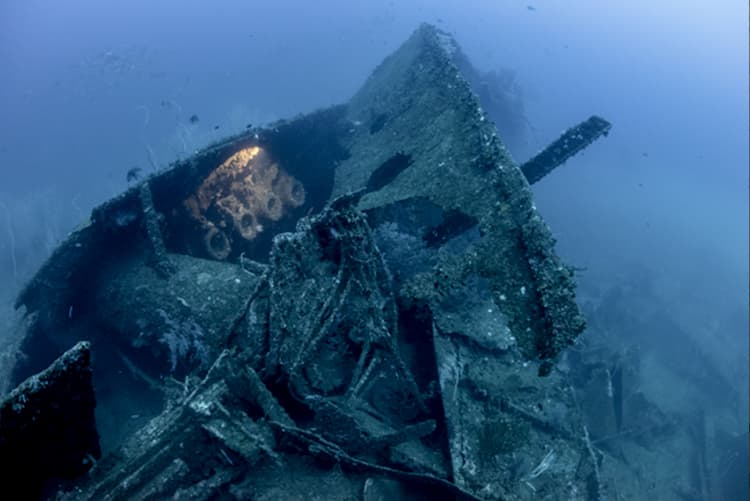
The world's first purpose-built aircraft carrier. 53 metres down. 307 men were lost here on 9 April 1942.
HMS Hermes was sunk by 70 Japanese dive bombers in just 10 minutes on 9 April 1942. 307 men were lost. The world's first purpose-designed aircraft carrier --- 182 metres long --- lies on its port side at 53 metres, covered in dense black coral trees. The 4-inch AA gun still points skyward. It is a British War Grave. Penetration is strictly prohibited. Technical diving certification and mixed gas (nitrox or trimix) are required. Non-certified guests take a guided reef dive at a shallower nearby site during this session and join the surface support vessel. This is one morning. It requires a full day of preparation and travel. One night.
Gate open at first light. The dive departs with a Sri Lanka Navy-approved technical operator. The hull rests on its port side --- one of the largest WWII wrecks in the Indian Ocean. The starboard propeller is clearly visible. The AA gun, identifiable and pointing skyward, as if still on watch. Black coral trees cover the steel work. Safe access requires advanced narcosis control and strict adherence to mandatory decompression schedules.
A guided reef dive at an accessible nearby site runs simultaneously for guests without technical certification. The surface boat connects both groups. Non-divers can snorkel or remain aboard.
Your Ophiro guide provides a full briefing on the events of 9 April 1942 before departure. The Japanese carrier force that attacked HMS Hermes was the same one that had attacked Pearl Harbor. Understanding what you are diving before you enter the water is part of the experience.
Pasikuda --- Catalina Y-78 & RFA SS Athelstane
Two wrecks from the same war. Two mornings in the same calm bay.
The Catalina PBY-5A flying boat (42 metres) was lost on 9 December 1943 after port engine failure during an emergency sea landing in severe rain and strong winds. All 11 crew survived. Wing sections, twin engine mounts, retractable main wheels, and twin propellers are clearly identifiable on a sandy seabed. The RFA SS Athelstane (37 to 43 metres) was sunk by Japanese bombs on the same day as HMS Hermes --- 9 April 1942 --- in the same air raid. All crew survived. Three distinct hull sections: bow at 37m with intact anchors and bow winch, bridge standing upright, stern at 43m with stern gun intact and propeller visible. Limited penetration into inner compartments is possible for qualified technical divers. Between dives: the calm turquoise bay at Pasikuda for snorkelling and rest. Two nights.
The wings, twin radial engine mounts, retractable main wheels, and twin propellers are all identifiable on the sandy seabed. The site confirms the scale and build of an amphibious patrol bomber that came down at sea in the night. Schools of fusiliers, snappers, and groupers have made the structure their home.
Three well-preserved sections across a gentle slope. The bridge stands upright despite the bomb damage --- unusual for a wreck of this age. The stern-mounted deck gun is intact, confirming the ship's armed support role. The hull supports soft and hard corals, rays, groupers, and lion fish. It is a British War Grave --- respectful diving conduct is required at all times.
The shallow turquoise lagoon at Pasikuda between dive sessions. The bay is one of the calmest on the east coast --- protected by a natural reef --- with warm, clear water and a sandy bottom accessible to non-swimmers and snorkellers at any level.
Arugam Bay --- the east coast close
After the wrecks, the present. The east coast at its most alive.
The journey closes deliberately. Arugam Bay after four days of WWII wrecks is a psychological decompression --- and a genuinely worthwhile destination in its own right. The Pottuvil Lagoon at dawn. The Muhudu Maha Viharaya cliff temple. The local food. The Point reef break for any surfers in the group. An optional night snorkel on the reef for those who want one more dive before departure. One to two nights.
Wild elephants come to the lagoon at dawn. A two-hour guided kayak through the channels before the wind builds --- elephants, estuarine crocodiles, and an extraordinary waterbird population in a setting that has no tourist infrastructure. This is the island's most unexpectedly dramatic morning after the wrecks.
A Buddhist temple on a small promontory south of the bay, overlooking the Indian Ocean. According to the ancient chronicles, this is where Princess Viharamahadevi landed after her legendary sea voyage from Kelaniya --- carried by the sea as a royal sacrifice. A journey built around the ocean should close at a temple above the same ocean that connects to it. This is the one.
A final snorkel on the reef at Arugam Bay in the evening light --- or after dark for those who want the night reef experience. The reef is accessible by short boat from the beach.
The cuisine of Arugam Bay reflects its east coast Tamil and Muslim heritage --- categorically different from the Colombo or southern coast versions. Your guide will know which roadside stall is correct.
**Technical dive requirements** HMS Hermes, Catalina Y-78, and RFA SS Athelstane (PKG 08A) all require technical diving certification (TDI, PADI TecRec, or equivalent) and mixed gas equipment (nitrox or trimix, depending on depth). Ophiro coordinates access with the Sri Lanka Navy Diving and Salvage Unit at shipwrecks.navy.lk and the Malima Diving Club at Trincomalee Naval Dockyard (+94 77 073 4380). Guests who are not technically certified participate in supported reef diving during wreck sessions on the surface support vessel. All wreck dive guests must present valid certifications at booking.